

In the 21st century, where we are dealing with digital transformation, financial C-suites are dealing with a different threat level among financial institutions that needs to be addressed as soon as possible. Here comes the European Union’s Digital Operational Resilience Act (DORA) that provides a common system of dealing with digital risk in financial institutions.
For executives, the regulation is not just a compliance matter but rather a matter of reinventing the ways of governance to guarantee continuity, accountability, and resilience. With the number and cost of cyber incidents increasing, by the end of 2026, the global damages will exceed $10.5 trillion every year, and in this case, DORA provides an organized way out.
Table of Contents
1. Understanding DORA and Its Strategic Intent
1.1 What is DORA Regulation in the European Union
1.2 Core Pillars of DORA Framework
1.3 Why DORA Signals a Shift in Digital Risk Governance
2. Operational and Compliance Impact on Financial Institutions
2.1 DORA Compliance Requirements for EU Financial Institutions
2.2 Third-Party Risk and ICT Vendor Oversight
3. The Future of Digital Risk Governance Under DORA
3.1 From Compliance to Continuous Resilience
3.2 Integration with Global Regulatory Trends
3.3 Strategic Opportunities for Competitive Advantage
Conclusion
1. Understanding DORA and Its Strategic Intent
1.1 What is DORA Regulation in the European Union
The Digital Operational Resilience Act (DORA) is a regulatory framework introduced by the European Union to enhance the IT security and resilience of financial institutions. It applies to banks, insurance firms, investment firms and critical third-party providers of ICT, which are located in the EU.
DORA establishes uniform standards in the management of digital risk, so that all financial organizations are capable of enduring, reacting to, and recuperating following ICT-related disturbances. In contrast to the previous instructions that dealt with cybersecurity in a piecemeal manner, DORA summarizes regulations into one enforceable rule. The European Central Bank reported that cyber attacks in the financial system had grown more than 50% between 2019 and 2023.
1.2 Core Pillars of DORA Framework
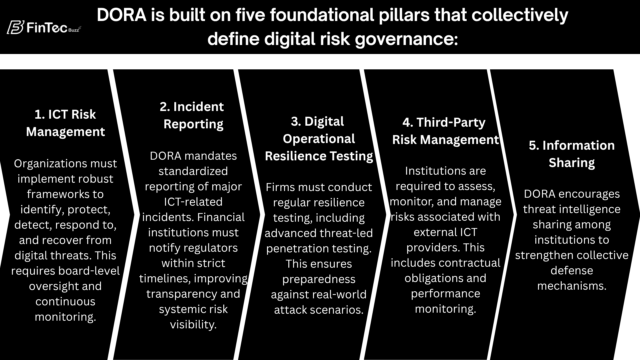
1.3 Why DORA Signals a Shift in Digital Risk Governance
DORA is a radical change in place of compliance-based risk management towards resilience-based governance. Traditionally, financial institutions concentrated on the minimum regulatory requirements and with DORA, financial executives can incorporate resilience into their operational strategy.
One key transformation is accountability, and senior management and boards having a direct role in digital resiliency, making it a governance priority rather than a technical issue.
Another shift is the move toward end-to-end risk visibility, where institutions need to risk-evaluate the whole digital supply chain, encompassing cloud providers and software vendors. This reflects findings from the World Economic Forum, which indicated that third-party vulnerability is the source of 60% of cyber breaches.
DORA also brings harmonization to the EU, eliminating regulatory fragmentation that provides a uniform working environment to the multinational financial institutions, enhancing efficiency and minimizing uncertainty in compliance.
2. Operational and Compliance Impact on Financial Institutions
2.1 DORA Compliance Requirements for EU Financial Institutions
DORA proposes elaborate compliance provisions that require structural and cultural adjustments in financial institutions, providing a holistic ICT risk management structure, which is backed by governance structures that encompass senior leadership. This involves the establishment of a risk tolerance threshold, controls and constant monitoring. Institutions have to categorize incidents according to their magnitude and provide major events within specific time frames. ENISA states that financial losses have traditionally risen, up to 30%, due to delayed reporting, and disclosures are necessary.
Compliance is focused on documentation and auditability and here, financial institutions should keep exhaustive documentation of the risk assessment, the response in case of an incident and its engagements with third parties.
According to a PwC survey, 68% of European financial companies anticipate that DORA compliance will rai se operational expenses in the short-term by a considerable amount. Nonetheless, long-term savings in terms of reduced incident impact and enhanced efficiency are also expected by many.
2.2 Third-Party Risk and ICT Vendor Oversight
Third-party risk management is one of the most transformative aspects of DORA therefore, banks are turning into more dependable customers of cloud computing, data analytics and software service providers. DORA would demand that companies perform stringent due diligence before hiring ICT providers therefore, contracts should also contain clear statements regarding security standards, incident reporting and audit access.
Constant surveillance in institutions should constantly review the performance of the vendors and their exposure to risks. These involve monitoring service outages, compliance, and cybersecurity posture.
The regulators are also given the authority to oversee key third-party providers because the regulation is no longer just limited to the financial institutions. The structure of DORA also makes sure that third-party risk is addressed in a systematic manner and the risk of cascading failures is minimized.
3. The Future of Digital Risk Governance Under DORA
3.1 From Compliance to Continuous Resilience
Organizations will transition to ongoing resilience and with DORA, financial executives can live monitoring, threat detection and dynamic risk assessment. Such technologies as machine learning and artificial intelligence will be critical in detecting anomalies and anticipating possible disruptions.
McKinsey reports that up to 70% of incident detection time can be reduced in organizations that embrace advanced analytics to manage risks. This is in line with the proactive defense mechanisms of DORA.
In the long run, resilience metrics will be turned into key performance indicators, which will impact strategic choices and investment priorities.
3.2 Integration with Global Regulatory Trends
DORA is not a lone entity, it is a larger international trend of enhancing the digital resilience of critical areas. Cybersecurity risk management and incident reporting are becoming a priority in the United States with the regulatory authorities. In the United Kingdom, operational resilience frameworks impose on firms the need to maintain services during stressful situations. Similar developments point to a convergence of regulations. Banking institutions in the global market need to coordinate their practices to suit various needs at the same time.
The standardized framework of DORA can be used as a basis for worldwide compliance. Embracing its principles, organizations will be able to simplify their models of governance and minimize the duplication of efforts. According to a 2024 survey by EY, 72% of multinational financial institutions are shifting to integrated risk management structures in an attempt to overcome regulatory complexity.
3.3 Strategic Opportunities for Competitive Advantage
Although DORA is said to be an additional burden to compliance, it has strategic opportunities. Companies that invest in resiliency can stand out in the market, as customers are becoming more focused on trust and reliability in their selection of financial services providers. Innovation is also promoted at DORA, which aids financial institutions in opening up and discovering new possibilities and business models by modernizing their IT infrastructure and implementing new technologies.
The progressive organizations will not see DORA as a regulatory force, but as an agent of change and a competitive edge. On the same note, according to the IBM Cost of a Data Breach Report, the average cost of a breach in the financial sector is put at a cost of 5.9 million dollars.
Conclusion
DORA presents a shift in the regulation of digital risk in the European financial sector. Creating a single and binding framework redirects the emphasis on compliance to resilience, silos to integration and reactive to proactive strategies. Implementation is the challenge, and transformation is the opportunity, as far as financial institutions are concerned.
Those who adopt DORA as a strategic project and not a regulatory burden will be in a better position to sail through an ever-complicated digital environment. Resilience will not only benefit organizations in the long run, but it will also determine their competitiveness and growth.
Stay Ahead of the Financial Curve with Our Latest Fintech News Updates!